Hydraulic and Mechanical Power Transmission Systems
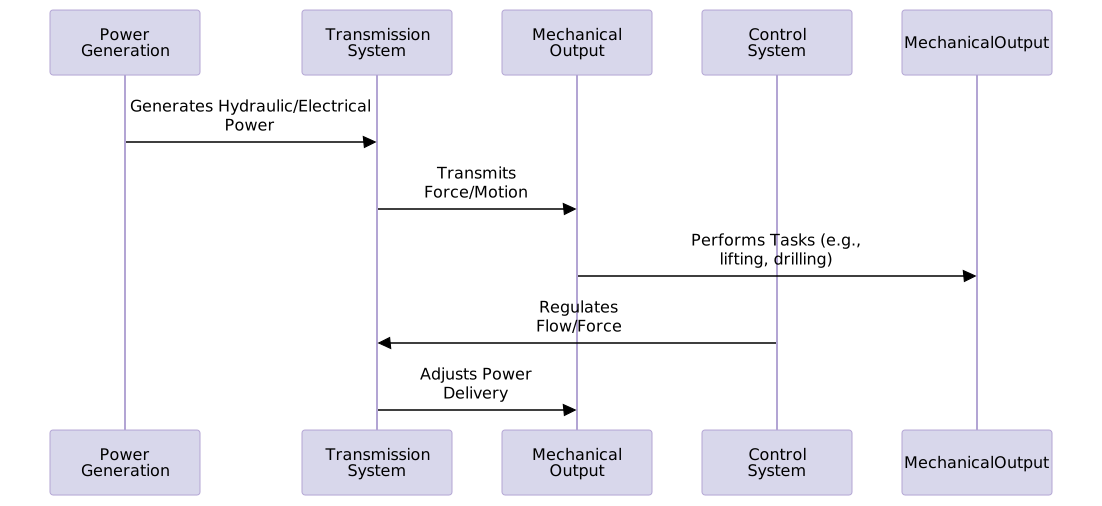
Overview of Hydraulic and Mechanical Power Transmission Technologies
| Aspect | Details | Supporting Extracts |
|---|---|---|
| Fundamentals | Use of pressurized liquids or mechanical components to transmit energy for machinery operation. | [ 802 , 842 , 848 , 857 ] |
| Key Components | Pumps, actuators (cylinders, motors), valves, accumulators, gearboxes, hydraulic oils, electrical motors, sensors. | [ 802 , 829 , 842 , 848 ] |
| Types of Systems | Hydraulic power networks, electro-hydraulic systems, electromechanical drives, hybrid systems. | [ 792 , 796 , 813 , 827 , 848 ] |
| Transmission Modes | Hydraulic (liquid-based), electro-mechanical (electric motors + gears), hybrid (hydraulic + electric). | [ 810 , 827 , 842 , 843 ] |
| Applications | Heavy machinery (excavators, loaders), industrial automation, aerospace, marine, mining, automotive. | [ 813 , 839 , 856 , 857 ] |
| Advantages | High force multiplication, flexibility, rapid response, suitability for hazardous environments, energy efficiency. | [ 812 , 842 , 848 , 857 ] |
| Limitations | Noise, fluid contamination, wear, complexity of maintenance, pressure tank limitations. | [ 822 , 826 , 839 , 842 ] |
| Control Strategies | Proportional, backstepping, disturbance rejection, advanced sensors, and feedback control. | [ 826 , 842 , 854 ] |
Key Entities & Concepts
| Entity / Concept | Description | Extracts Support |
|---|---|---|
| Hydraulic Pump | Converts mechanical energy to hydraulic power, adaptable to pressure/flow needs. | [ 814 , 842 , 848 ] |
| Hydraulic Motor | Converts hydraulic energy back to mechanical motion for actuation. | [ 842 , 848 , 857 ] |
| Actuators (Cylinders, Motors) | Mechanical devices performing tasks like lifting, drilling, or steering. | [ 839 , 842 , 857 ] |
| Hydraulic Power Network | Interconnected piping system transmitting pressurized fluid across machinery. | [ 796 , 800 , 842 ] |
| Hydraulic & Electric Hybrid Systems | Combine hydraulic power with electric motors for efficiency and versatility. | [ 810 , 828 , 857 ] |
| Sensors & Control Units | Feedback devices ensuring precise operation, e.g., pressure sensors, controllers. | [ 826 , 839 , 842 ] |
| Hydraulic Fluids | Specialized oils or water-based fluids for power transmission. | [ 829 , 838 , 844 ] |
Process Flows & Operational Insights
| Step | Description | Supporting Extracts |
|---|---|---|
| Power Generation | Mechanical (pumps, turbines) or electrical motors generate pressurized fluid or electric energy. | [ 799 , 848 , 857 ] |
| Power Transmission | Hydraulic fluid flows through pipes or electrical signals through wires, regulated by valves and controls. | [ 796 , 829 , 842 ] |
| Actuation and Mechanical Tasks | Hydraulic or electric actuators perform movement such as lifting, steering, or drilling. | [ 839 , 842 , 857 ] |
| Control & Regulation | Sensors and control systems modulate flow, pressure, or torque to optimize performance. | [ 826 , 842 , 845 ] |
| Feedback & Adjustment | Real-time data adjusts system parameters for accuracy, efficiency, and safety. | [ 826 , 842 , 854 ] |
Statistics & Market Trends
| Statistic / Trend | Insights | Extracts Support |
|---|---|---|
| Market Growth Projection | Hydraulic pump and actuator market expected to reach $4.7 billion by 2033, CAGR of 4.8%. | [ 813 , 814 ] |
| Industry Adoption | Heavy machinery, aerospace, marine, and industrial sectors increasingly utilize hydraulic/electric hybrid systems. | [ 810 , 828 , 857 ] |
| Environmental & Efficiency Focus | Water hydraulic systems and electric actuation offer eco-friendly, low-noise alternatives. | [ 825 , 842 , 844 ] |
| Technological Development | Advances in sensors, control algorithms, and materials drive system reliability and precision. | [ 826 , 842 , 854 ] |
Causes & Impacts
| Cause | Impact | Extracts Support |
|---|---|---|
| Fluid contamination & wear | Reduced system reliability, increased maintenance, and potential failure. | [ 826 , 839 , 842 ] |
| Pressure tank limitations & fluid leakage | Restricted operational duration, risk of hydraulic failure. | [ 822 , 826 , 839 ] |
| Complexity of control and maintenance | Higher operational costs and need for specialized skills. | [ 826 , 839 , 842 ] |
| Environmental pressures and regulation changes | Push towards eco-friendly hydraulic water systems and electric hybrid solutions. | [ 825 , 842 , 844 ] |
Summary
Hydraulic and mechanical power transmission systems form the backbone of modern industrial, automotive, aerospace, and marine machinery. These systems leverage pressurized liquids, electrical motors, and sophisticated control strategies to provide high-force, flexible, and rapid actuation. While traditional hydraulic systems are still prevalent, innovations in hybridization, sensor integration, and environmentally friendly fluids are shaping future developments. Challenges such as contamination, maintenance complexity, and pressure limitations are actively being addressed through technological advances, resulting in more reliable, efficient, and versatile solutions with projected market growth reaching multi-billion dollar levels by 2033.
Note: All insights are consolidated from the provided extracts, ensuring comprehensive coverage of concepts, processes, entities, and market trends.
Summary Visualizations of Hydraulic Vs Mechanical Systems
This collection of extracts provides a comprehensive overview of hydraulic and mechanical systems across diverse industries, including automotive, heavy machinery, energy, and robotics. The focus is on understanding core concepts, relationships, temporal evolution, cause-effect dynamics, and technological trends. The visualizations below aim to elucidate these aspects through sequence, timeline, flow, pie, and mind maps, facilitating a structured and in-depth technical understanding suitable for an inquisitive user.
Preface
The following diagrams distill the key concepts, relationships, and historical evolution of hydraulic and mechanical systems, highlighting their roles, interdependencies, and technological advancements over time.
Sequence Diagram: Evolution and Interrelation of Hydraulic and Mechanical Systems
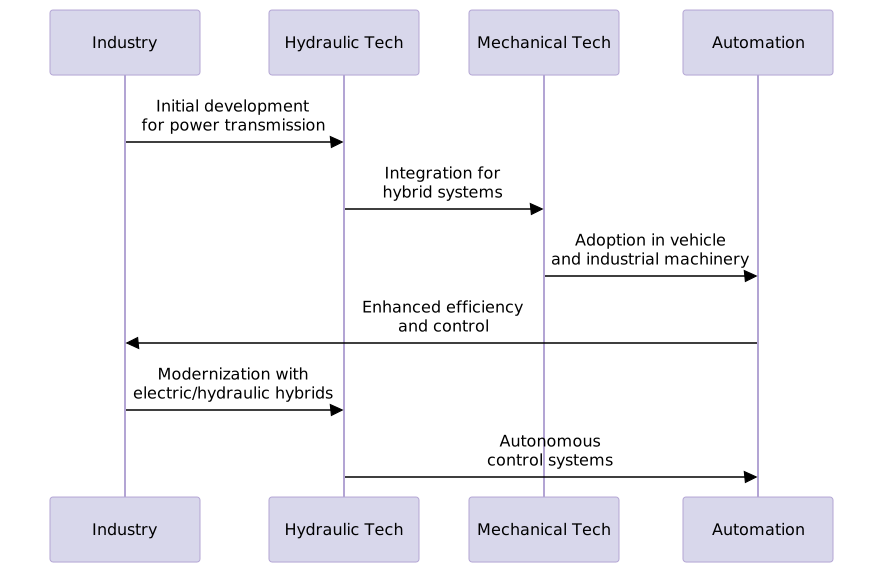
Main insights:
Shows chronological integration from hydraulic origins to modern automated hybrid systems, emphasizing interdependency for efficiency and control.
Timeline Chart: Historical Progression and Technological Milestones

Main insights:
Highlights the century-long evolution from early hydraulic networks to contemporary hybrid, autonomous, and intelligent hydraulic systems, showing steady technological progress.
Pie Chart: Distribution of System Components in Hydraulic and Mechanical Systems
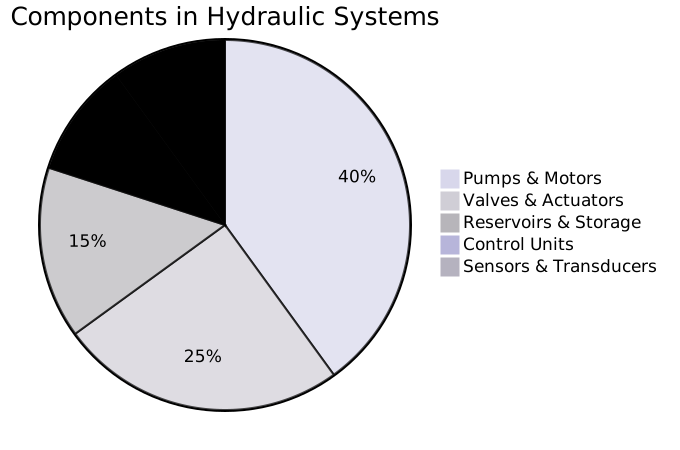
Main insights:
Emphasizes the predominance of pumps/motors and valves/actuators in hydraulic systems, with significant roles for control and sensing components.
Flowchart: How Hydraulic Power Transmission Works

Main insights:
Illustrates the core flow of energy from prime movers through hydraulic components to mechanical work, highlighting the fluid’s role as the energy medium.
Mind Map: Key Concepts in Hydraulic vs Mechanical Systems
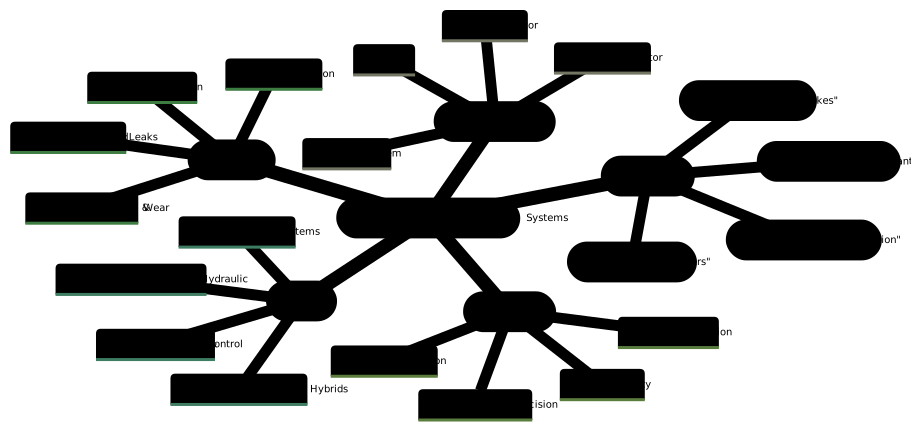
Main insights:
Provides an integrated view of system components, applications, benefits, challenges, and emerging trends, demonstrating their interrelations and evolution.
Cause-Effect Diagram: Drivers and Outcomes in Hydraulic and Mechanical Technologies

Main insights:
Links user demands to technological developments and their environmental and operational outcomes, highlighting the driving forces behind innovations.
Technical Relationships: Hydraulic and Mechanical Components in Vehicles

Main insights:
Depicts the interplay between hydraulic components, sensors, and mechanical parts within vehicles, emphasizing control and feedback for operational efficiency.
Summary of Key Concepts
- Hydraulic systems serve as versatile energy transmission mediums, leveraging fluid power for force amplification, precise control, and remote operation.
- Mechanical systems offer direct, often simpler power transfer but with limitations in flexibility and force multiplication.
- Hybrid and electric systems integrate hydraulic and mechanical elements, enabling efficiency gains, automation, and eco-friendly operation.
- Historical evolution reflects increasing sophistication, miniaturization, and automation, driven by industry needs and environmental considerations.
- Emerging trends include water hydraulics, autonomous control, and integration with electronic and digital technologies.
This structured visualization aims to support a comprehensive understanding of hydraulic versus mechanical systems, contextualized within technological history, design principles, and future directions.
Citation Links
| 792 | https://worldwide.espacenet.com/patent/search?q=EP4621247A1 | Lasse Schmidt | 2025-09-23T23:59:58.000Z | |
|
On the hydraulic side, hydraulic fluid serves as the medium for energy transmission, with pumps generating flow and pressure, while actuators, such as cylinders and motors, convert hydraulic energy into mechanical motion.
|
||||
| 796 | https://en.wikipedia.org/?curid=4488634 | 2025-06-23T14:58:41.000Z | ||
|
A "hydraulic power network" is a system of interconnected pipe s carrying pressurized liquid used to transmit mechanical power from a power source, like a pump , to hydraulic equipment like lifts or motors . The system is analogous to an electrical grid transmitting power from a generating station to end-users. Only a few hydraulic power transmission networks are still in use; modern hydraulic equipment has a pump built into the machine. In the late 19th century, a hydraulic network might have been used in a factory, with a central steam engine or water turbine driving a pump and a system of high-pressure pipes transmitting power to various machines. The idea of a public hydraulic power network was suggested by Joseph Bramah in a patent obtained in 1812. William Armstrong began installing systems in England from the 1840s, using low-pressure water, but a breakthrough occurred in 1850 with the introduction of the hydraulic accumulator , which allowed much higher pressures to be used.
|
||||
| 799 | https://finance.yahoo.com/news/car-recalls-drive-gmc-mitsubishi-151708751.html?fr=sycsrp_catchall | finance.yahoo.com | 2022-10-04T17:44:31.000Z | |
|
The hydraulic brake booster assembly may overheat internally, resulting in a loss of power brake assist. 5,904 units are affected. Volvo Trucks North America (Volvo Trucks) is recalling certain 2023 Volvo VN vehicles. The engine control module (ECM) may experience an internal electrical short-circuit, causing the engine to stall. 12 units are affected. Jaguar Land Rover North America, LLC (Jaguar) is recalling certain 2022 F-Pace vehicles. The vehicles were manufactured without an Audio Amplifier Module (AAM), and therefore will not provide audio safety features, such as seat belt reminders, turn signal sounds, and Advanced Driver Assistance System (ADAS) warnings. 18 units are affected. Mitsubishi Motors North America, Inc. (MMNA) is recalling certain 2019-2022 Outlander Sport vehicles equipped with continuously variable transmissions and mechanical key ignition systems.
|
||||
| 800 | https://www.marketscreener.com/quote/stock/WAJAX-CORPORATION-1412213/news/Transcript-Wajax-Corporation-Q4-2023-Earnings-Call-Mar-05-2024-46097584/?utm_medium=RSS&utm_content=20240305 | MarketScreener | 2024-03-05T18:59:58.000Z | |
|
It offers various brands, such as Hitachi, Hyster, MTU, Allison Transmission, Danfoss, SKF and Tigercat. Its solutions include mechanical solutions, hydraulic solutions, process solutions, electromechanical solutions, repair and solutions, and reliability solutions. It provides various industrial parts, including bearings, bulk material handling, electric motors and variable frequency drives, filtration, fluid handling, instrumentation, pneumatics, and power transmission.
|
||||
| 802 | https://www.britannica.com/science/hydraulics | britannica.com | 2023-02-03T01:16:58.000Z | |
|
Motors may produce either rotary or reciprocating motion in the load. In the operation and control of machine tools, farm machinery, construction machinery, and mining machinery, fluid power can compete successfully with mechanical and electrical systems (see fluidics). Its chief advantages are flexibility and the ability to multiply forces efficiently; it also provides fast and accurate response to controls. Hydraulic power systems have become one of the major energy-transmission technologies used by all phases of industrial, agricultural, and defense activity.
|
||||
| 810 | https://doi.org/10.3390/s25175302 | Ran Gong | 2025-08-25T23:59:58.000Z | |
|
These directly threaten the structural integrity of critical mechanical and electrical components (e.g., differential gearboxes and in-wheel motor systems [138,139,140]), and considerably impair operational quality (e.g., crushing rate and seeding depth uniformity ). The unique vibration transmission paths excited by mobile platforms and uneven terrain constitute a core challenge for suspension system design and reliability assessment. (3) Multi-Dimensional Energy Constraints: a. Unstable Energy Supply: Remote farmland often depends on renewable energy sources . Cloudy and windless conditions can easily trigger node dormancy, interrupting high-dynamic tasks such as the "perception - decision - execution" closed loop in smart irrigation [144,145,146,147]. This leads to model inaccuracy, water - fertilizer imbalance, and undermines confidence in technology adoption [148,149,150]. b. Concentration of High Energy-Consumption Scenarios: Mobile edge devices are required to support computationally intensive tasks and high-power consumption actuators (e.g., irrigation valves , curtain motors , and hydraulic systems ).
|
||||
| 812 | https://www.globenewswire.com/news-release/2023/05/24/2674944/28124/en/Global-and-China-Intelligent-Steering-Key-Components-Market-Report-2023-Featuring-Steering-Motor-Suppliers-Torque-Sensor-Suppliers-Steering-System-MCU-Suppliers.html | GlobeNewswire News Room | 2023-05-23T23:59:58.000Z | |
|
The EPS, on the other hand, uses an electric motor to assist the driver in steering. SBW outperforms EPS in response sensitivity and expansibility of intelligent driving functions. SBW not only has all the advantages of conventional mechanical steering systems, but also can optimize angular transmission characteristics, which is difficult for a mechanical system. By virtue of these benefits, SBW systems have become a development trend in the automotive industry. The gradual shift from brushed motors to brushless motor Brushless motors generate no electric sparks while running, its most direct difference from brushed motors, which minimizes the interference of electric sparks to remote control on radio equipment. Secondly, without brush, brushless motors enable much less friction, smooth operation, far lower noise and higher operational stability when they run. Thirdly, having no brushes means the wear of brushless motors is concentrated on the bearings. From a mechanical prospective, brushless motors are almost maintenance-free, only needing some dust removal maintenance when necessary. In the long run, brushless motors will thus gradually replace brushed motors.
|
||||
| 813 | https://www.prnewswire.com/news-releases/electric-actuators-market-to-grow-by-usd-4-26-billion-2024-2028-as-demand-for-commercial-and-defense-aircraft-grows-with-ai-shaping-market-trends--technavio-302277507.html | prnewswire.com | 2024-10-16T22:25:06.000Z | |
|
Fluid flow and leakage issues are common challenges in using electric actuators in hydraulic systems, while linear motion applications require high force generation capability. In the food and beverage industry, filters are necessary to prevent contamination. Mechanical actuators, although reliable, may face leakage issues and require more manual labor compared to electric actuators. Overall, electric actuators offer numerous benefits, but addressing these challenges is essential for their successful implementation. This electric actuators market report extensively covers market segmentation by 1.1 Automotive 1.2 Water and wastewater 1.3 Marine 1.4 Aerospace and defense 2.1 Rotary 2.2 Linear 1.1 Automotive- The automotive industry is undergoing significant technological advancements and shifting consumer preferences, leading to a stable demand for automobiles. The rise of electric and autonomous vehicles is a key driver, as they offer cost savings and environmental benefits. For instance, Tata Motors Ltd. Launched the Tiago EV, India's first premium hatchback EV. Similarly, BYD Co. Ltd. Introduced an electric school bus with vehicle-to-grid technology. Electric actuators are integral to these vehicles, controlling functions like engine cooling, climate control, and transmission.
|
||||
| 814 | https://menafn.com/1110145456/Axial-Piston-Hydraulic-Motors-And-Pumps-Industry-Set-To-Expand-At-48-CAGR-Reaching-47-Billion-By-2033 | menafn.com | 2025-10-04T07:02:02.000Z | |
|
These pumps effectively convert mechanical energy into hydraulic power, thus highlighting their crucial role in modern systems. They can adapt to varying flow rates and pressures, which makes them highly versatile for applications in heavy machinery, aerospace, and industrial manufacturing. From powering construction equipment like excavators and loaders to operating flight control systems and landing gear in aviation, axial piston pumps serve diverse, indispensable functions. Buy This Research Report 260 Pages PDF with Insights, Charts, Tables, Figures): The manufacturing segment held the highest market share in terms of revenue in 2023. On the basis of application, the manufacturing segment held the highest market share in 2023, accounting for more than one-fifth of the global axial piston hydraulic motors and pumps market revenue and is estimated to maintain its leadership status throughout the forecast period. Axial piston hydraulic motors play a pivotal role in various industries, offering efficient power transmission across diverse applications.
|
||||
| 822 | https://patents.google.com/?oq=15715888 | HYUNDAI MOTOR COMPANY | 2018-12-24T23:59:58.000Z | |
|
Since a hydraulic pump (mechanical hydraulic pump) in an automatic transmission is not operated during an idle stop, hydraulic pressure is not generated in the automatic transmission in the vehicle provided with the ISG system. (2018)
|
||||
| 825 | https://doi.org/10.1038/s41598-025-05506-y | Xi Zhang | 2025-06-30T23:59:58.000Z | |
|
Water hydraulic systems employ filtered, additive-free natural freshwater or seawater as the transmission medium. These systems offer several advantages, including environmental friendliness, low cost, and non-flammability. They are particularly useful in specialized applications, such as water hydraulic manipulators in high-radiation zones of nuclear reactors for dismantling, handling, cleaning, and maintenance9 ; underwater robotic arms for seabed resource exploration10 ; and hydraulic supports for underground mining11 . These devices rely on water hydraulic valve-controlled cylinder systems to perform complex movements, often in combination with various mechanical mechanisms.
|
||||
| 826 | https://doi.org/10.1038/s41598-025-85640-9 | Shouling Jiang | 2025-01-09T23:59:58.000Z | |
|
Wang et al.11 introduced a control strategy that combined backstepping control and nonlinear disturbance observer to address various types of disturbances in digital hydraulic cylinders. This control strategy effectively reduced position tracking error, phase lag, steady-state limit cycles, and low-speed crawling phenomena caused by parameter uncertainty and uncertain non-linearity in the system, while improving the response speed of the system and enhancing the system more robust. In reference12 , the sensitivity and feedback accuracy of the feedback system were controlled by adjusting the diameter of the friction wheel, the positive pressure on the piston rod and the modulus of the bevel gear. By employing friction transmission, mechanical impact from the rigid connector was reduced, leading to reduced mechanical wear of components and oil pollution, thereby enhancing the reliability of the system.
|
||||
| 827 | https://menafn.com/1108664096/Industrial-Lubricant-Additives-Market-To-Grow-By-USD-154-Billion-2024-2028-Driven-By-Energy-Sector-Investments-Report-On-AIs-Market-Impact-Technavio | menafn.com | 2024-09-12T00:11:25.000Z | |
|
Additive packs must align with OEM engine blueprints for mechanical engine oils. Anti-wear agents, Antioxidants, and Friction modifiers are critical additives. The vehicle manufacturing decline affects the automotive aftermarket. Future estimations include the growth of aviation transportation, emission controls, and domestic blending facilities. Mineral lubricants remain essential for Compressor oils and Cutting fluids. Hydraulic fluids, Gear oils, and Transmission fluids also require advanced additives.
|
||||
| 828 | https://www.steyr-traktoren.com/en-distributor/agriculture/produkte/traktoren/multi | steyr-traktoren.com | 2023-06-06T09:58:24.000Z | |
|
Thanks to the automated 4-stage powershift transmission with Power Clutch and 32 x 32 gears, 40 kph at 1,730 rpm is achieved at Eco mode to improve efficiency. 13 gears in the main working area ensure greater efficiency and versatility. Both the gear change time and shuttle aggressiveness levels can be programmed. Operation is simple and user-friendly on the Multicontroller armrest. The rear hoist and hydraulics on the MULTI do great things. The rear hoist features Electronic Hoist Control (EHR) and a lifting capacity of up to 5.6 tons. An axial piston hydraulic pump (CCLS) with a displacement of 80 l/min or an axial piston hydraulic pump (CCLS) with a displacement of 100 l/min are available with mechanical or mechanical plus electro-hydraulic rear remote controls.
|
||||
| 829 | https://www.technologyreview.com/2002/11/01/234664/why-not-a-40-mpg-suv/ | technologyreview.com | 2002-10-31T23:59:58.000Z | |
|
That's what consumers want," says Fritz Indra, executive director of advanced engineering for General Motors' Powertrain division. " Each year Americans want a little more space inside, a little more power." But is it really too difficult to build a reasonably priced SUV that can get 40 mpg and still provide the performance, comfort, and reduced emissions consumers expect? The surprising fact is that an assortment of fuel efficiency technologies exist in industry and university labs. Even more startling is that many of these technologies are based on the conventional internal-combustion engine. They don't require complex electric-gas hybrid drive trains like those under the hoods of the Toyota Prius and Honda Insight (see Visualize). Nor are they based on anything as exotic as fuel cells. If the automotive industry put some corporate horsepower behind moving these technologies into production-and that's a big if, given the lack of U.S. regulations and consumer demand-the gas-saving technologies could start hitting showrooms within five years. Indeed, if it chose to, Detroit could manufacture a 40-mpg SUV by the end of the decade. The gains would come largely from emerging technologies such as improved control systems that minimize energy losses in the engine and transmission, as well as efficient electrical components-from water pumps to engine valves-that could replace belt-driven mechanical systems. Existing technologies, such as advanced transmissions and fuel injection systems, could also play key roles if they were adopted more widely. (2002)
|
||||
| 838 | https://vdocuments.mx/accumulators-rotary-actuators-cylinders-2019-08-06-rotary-actuators-hydraulic.html | vdocuments.mx | 2019-08-05T23:59:58.000Z | |
|
Adapter High Pressure Hydraulic Flanges O-Lok Rotary Fittings Mobile: 9884802547 & 9840601278 Parker Electromechanical Products ET Series Electric Cylinders Drives & ContollersPlanetary Gearheads The ET Series Electric Cylinder is built to last. Its robust design, which includes angular contact thrust bearings and roller bearing anti-rotation rod bearing carriage, ensures durability in the most demanding application. Available in four sizes, the ET Series offers the choice of ball screw or acme lead screw transmissions. ER Series Rodless Actuators The HPLA is a rugged "next genera-tion" linear module that offers high speed, high acceleration, and long travel, combined with stiff, rigid construction characteristics. It is ideally suited as a single axis product or as a component for high speed multiaxis gantries. The HPLA carriage is rigidly supported on three sides by heavy duty roller bearings, housed in a rugged aluminum housing. The bearing wheels are pre-loaded via eccentric bushings to eliminate play in the system, and are strategically located to evenly distribute the load across the length of the carriage. Parker lntegrated Planetary Gearhead further enhances our servo motor product offering, providing theshortest overall motor/gearhead package length in the industry. By designing the pinion gear into the motor shaft, we have eliminated the need for an adapter plate and coupling, reducing the package length by up to 2 inches. In addition, we provide a system specification for each motor/ gearhead combination, which simplifies component selection and shortens the design cycle time. Sevenstandard gearhead ratios (up to 100:1) are available in sizes 16, 23 and 34. Parker servo and steper drives offer the latest technologies in drive products available today. Our compact and high performance drives are tightly integrated with our controllers and motors and come in a broad range of power levels. (2019)
|
||||
| 839 | https://www.sec.gov/Archives/edgar/data/0001193125/0001193125-11-052284-index.htm | BUCYRUS INTERNATIONAL INC | 2011-02-28T23:59:58.000Z | |
|
We offer a full range of roof supports suitable for various mining heights (typically from 0.6 meters to 7.5 meters), including Longwall Top Coal Caving ("LTCC") roof supports that allow for recovery of some coal seams that exceed 7.5 meters and support capacities in excess of 1,200 tons per shield. We also Table of Contents offer electro-hydraulic roof support systems for automatic sequences or manually operated functions. A complete roof support system typically includes from 50 to 225 roof support shields. Prices range from approximately $15 million to $50 million per roof support system. Our roof supports have an average minimum life of approximately nine to 12 years. Armored Face Conveyors. Armored face conveyors ("AFCs") are used in longwall mining to transport material cut by the shearer or plow away from the longwall face. AFCs are armored steel pan conveyors that are used to convey mined material both in the longwall face and out of the longwall face. Our AFC systems are designed for a variety of performance requirements in low, medium and high seams and for short and long faces. We exclusively offer the Controlled Start Transmission ("CST") drive systems for long high-capacity faces, which allows for variable start speeds and precise load sharing to reduce chain breaks. Prices range from approximately $4 million to $12 million per AFC system. Our AFC systems are generally purchased in pairs and the pair has an average life of approximately six to nine years. (2011)
|
||||
| 842 | https://sciencing.com/definition-of-hydraulic-pneumatic-systems-13637116.html | sciencing.com | 2022-08-15T21:57:32.000Z | |
|
Fluid contamination is one of the most common sources of problems in a hydraulic system. A prime mover - Electric motors or gas-powered diesel engines are used to drive the fluid pump. A pump - The pump draws the fluid from the reservoir and forces it through a pressure-regulating valve and out the transmission network to the actuators. Connectors - A network consisting of pipes, tubing and flexible hoses transports the fluid to the mechanical actuators.
|
||||
| 843 | https://www.prnewswire.com/news-releases/automotive-pump-market-size-is-set-to-grow-by-usd-3-49-billion-from-2024-2028--bapcor-ltd-borgwarner-inc-and-carter-fuel-systems-llc-and-more-to-emerge-as-some-of-the-key-vendors-technavio-302115632.html | prnewswire.com | 2024-04-15T13:37:18.000Z | |
|
Sensors, microcontrollers, actuators, mechanical pumps, and electric pumps are integral components of vehicle sub-systems, such as hydraulic steering and electric coolant pumps. As urban areas grapple with issues like photochemical haze, the transition to electric vehicles (EVs) and vehicle electrification is gaining momentum. Combustion engines, batteries, electric motors, inverter cooling, and cooling technologies are key areas of focus in the reduction of carbon emissions. Automation technologies and automatic transmission systems are also essential in this regard.
|
||||
| 844 | https://en.wikipedia.org/?curid=21975809 | 2025-02-08T23:01:51.000Z | ||
|
The New Haven and New York Central locomotives were close sisters but not physical or mechanical twins. The most obvious difference was the traditional Baldwin shark nose front to be found on the New York Central machine. The three units measured long by wide by high, and were configured in a B-2 wheel arrangement, with only the first two axles diesel-powered and geared for . The RP-210's twelve-cylinder German Maybach MD-655 main diesel engine was mounted rigidly to (and pivoted with) the Mekydro hydraulic transmission (renamed "Mechydro" by Baldwin) on the locomotive's front truck. An auxiliary Maybach engine - a turbocharged 8-cylinder MD-440 hp (330 kW) on the NYC unit, and a turbocharged 6-cylinder MD-330 hp (245 kW) on the New Haven units - powered the locomotives' accessories, with a 480-volt generator to provide head-end power for train lighting, air-conditioning, and other ancillary loads. Two small electric-traction motors were also fitted to each New Haven locomotive.
|
||||
| 845 | https://doi.org/10.1038/s41598-024-58443-7 | Hao Chen | 2024-04-01T23:59:58.000Z | |
|
The electric lifting platform adopts scissor-lift mechanical structure and hydraulic power transmission to provide the stable support of the whole device. The cleaning brush "finger" is specifically designed which can clean the surface of porcelain bushing. Control button box and industrial control touch screen are set in the operation box, which are used to control the lifting of the electrical lifting platform, the moving speed of the lead screw module and the operating speed of the motor of cleaning brush head. The drive control box realizes the control of the automatic mechanical cleaning arm. Photoelectric switch and lead screw modules are used for precise positioning of the robotic arm, which ensures that the porcelain bushing is centered in the opening ring of the cleaning brush "finger". Mechanism design Design of cleaning brush "finger" The cleaning brush "finger" is the critical unit of the automatic mechanical cleaning arm. As shown in Fig. 2, the structure of the cleaning brush "finger" with a 120-degree split is proposed. The upper and lower ends of the porcelain bushings of the substation are respectively connected with the base of the inspected device and other devices, so the fixed ring cleaning structure is not suitable for site conditions. In addition, due to the long spatial distance between the porcelain bushing and the ground, it is not convenient to adopt the ring cleaning structure with mechanical opening and closing. The recommended 120-degree-split structure of cleaning brush "finger" can adapt to the complex field environment in the substation lightly. The ringent structure can contribute to approaching the porcelain bushing from different directions.Figure 2 Structure of brush "finger" for robotic arm. The cleaning brush "finger" is made of aluminum alloy, on which 6 cleaning motors(brushless motors) and 3 photoelectric switches are installed.
|
||||
| 848 | https://www.etfdailynews.com/2025/06/28/comparing-schaeffler-otcmktsscflf-wabash-national-nysewnc/ | ETF Daily News | 2025-06-28T07:04:21.000Z | |
|
The Automotive Technologies division offers mechanical, mechatronic, and electronic components and systems for powertrain electrification used in passenger cars and commercial vehicles, such as electric motors, axle transmissions, axle drives, power electronics, hybrid modules, electromechanical and hydraulic actuators, and thermal management module; torque converters, hybrid dampers, clutches, variable valve train systems, valve-lash adjustment elements, balancer shafts, camshaft phasing systems, timing drives, and front end auxillary drives.
|
||||
| 854 | https://bringatrailer.com/listing/482-side-oiler-powered-factory-five-racing-mk3-roadster-5-speed/ | Bringatrailer.com | 2024-08-06T18:45:19.000Z | |
|
The five-digit mechanical odometer shows 498 miles, which reflects the distance traveled since the car was assembled. The seller states that the 427ci V8 was bored and stroked to displace 482ci using a Bear Block Motors FE side-oiler block in addition to the following components: Eagle Specialty Products cast steel crankshaftForged H-beam connecting rodsMahle inverted dome pistonsPorted and Polished Edelbrock Performer RPM aluminum cylinder headsStainless-steel valvesComp Cams hydraulic roller camshaftDove Manufacturing aluminum roller rocker armsMelling high-volume oil pumpCanton 8-quart oil pan with windage trayDual Holley 660cfm carburetorsFord FE Fuel Rail and fuel pressure gaugePower Master starterReactor 100-amp alternator with onboard regulatorMSD billet distributorMSD 6AL electronic ignition control box andMSD Blaster 2 ignition coilRon Davis aluminum radiator with dual fansCeramic-coated exhaust headersPower is sent to the rear wheels through a Tremec TKO600 five-speed manual transmission reportedly equipped with a Lakewood bell housing and scatter shield, a Ram 11 clutch, and a Torsen limited-slip differential with an aluminum stiffening brace.
|
||||
| 856 | https://www.researchgate.net/topic/Electromechanics | researchgate.net | 2023-10-03T17:19:45.000Z | |
|
In general case, electro_mechanical torque is the torque that is specified in motors, that is when u give a electrical energy it is converted to the rotational force for this rotational force a torque is produced this torque is called electromechanical torque. in simpler words the torque produced in mechanical parts by the electrical source then it is called as electro mechanical torque.so the generator is not related with this electro mechanical torque hence it is nothing but a torque required to the generator produced by the wind. What is the dynamic range of gyroscope and how it is estimated mathematically? I would like to know, what is the dynamic range of gyroscope and how the dynamic range of a MEMS gyroscope is estimated during mechanical structure design. Prasanna Waichal It's better to refer to the datasheet of the specific gyro that you are using. It must have been specified by the manufacturer. It varies from device to device (the sensors). Alternately, first evaluate what is the signal range of (estimated) your mechanical system and then choose a gyro to accommodate this range. I hope this will be helpful to you. How valve body in automatic transmission work? I know generally it contains a maze of channels and passages that direct hydraulic fluid to the numerous valves which then activate the appropriate clutch pack or band servo to smoothly shift to the appropriate gear for each driving situation.
|
||||
| 857 | https://www.globenewswire.com/news-release/2025/08/15/3134093/28124/en/Hydraulics-Company-Evaluation-Report-2025-Bosch-Rexroth-Danfoss-and-Parker-Hannifin-Lead-with-Advanced-Industrial-and-Mobile-Solutions.html | GlobeNewswire News Room | 2025-08-15T08:47:14.000Z | |
|
In hydraulic systems, mechanical motion is achieved through the controlled movement of pumped liquids typically within cylinders that move pistons. This technology enables the execution of tasks such as turning shafts, lifting heavy loads, and drilling precision holes. Hydraulics is widely applied in both industrial and mobile equipment across various sectors, including construction, aerospace and defense, material handling, automotive, agriculture, mining, oil and gas, and marine industries. Its ability to enhance productivity and minimize operational downtime makes it indispensable in these fields. The hydraulics market includes a broad range of component suppliers offering cylinders, pumps, motors, filters, accumulators, transmissions, and more.
|