Fundamentals and Evolution of Stealth Aircraft Technology
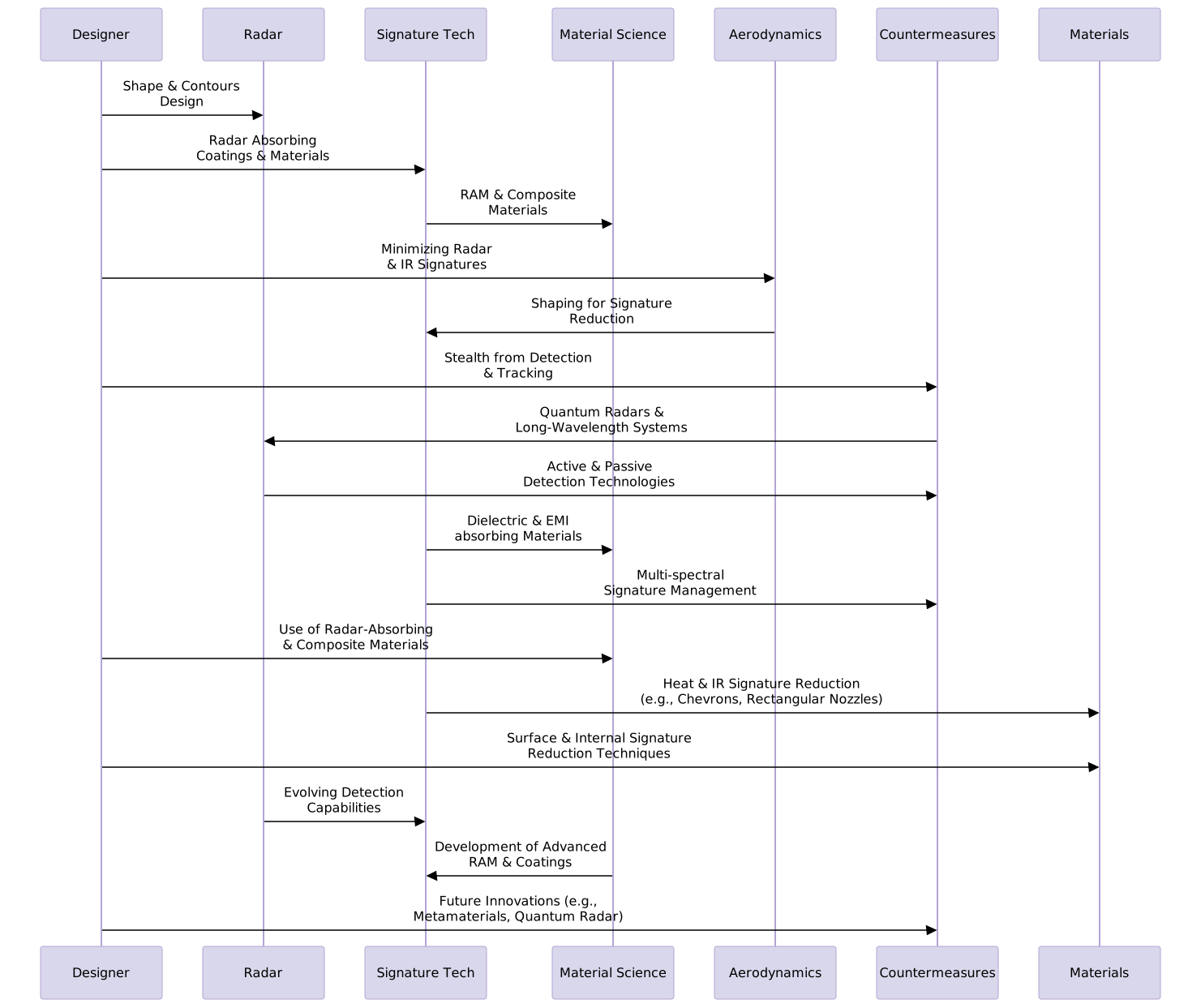
Signature Technologies and Their Integration
| Component/Aspect | Details / Insights | Supporting Extracts |
|---|---|---|
| Radar Signature | Achieved through shaping (curved surfaces, flat planes) and radar-absorbent materials (RAM). Shaping reduces reflections; RAM absorbs incident radar waves [ 129 , 135 , 140 ~ 142 ]. | [ 129 , 135 , 140 ~ 142 ] |
| Infrared Signature | Reduced via internal engine placement, chevron nozzles, mixed exhaust gases, and heat shielding. Rectangular nozzles promote rapid cooling of exhaust gases, lowering IR detectability [ 167 , 168 , 187 , 213 ]. | [ 167 , 168 , 187 , 213 ] |
| Visual & Acoustic Signatures | Visual signatures minimized by camouflage and material coatings; acoustic signatures suppressed through design of engine intake/exhaust and noise reduction techniques [ 141 , 187 , 216 ]. | [ 141 , 187 , 216 ] |
| Material Innovations | Use of composites, radar-absorbent coatings, dielectric loss materials, and nanostructured RAM. Examples include china clay-based bioceramics and ferrite particle embedded materials [ 177 , 224 , 226 , 239 ]. | [ 177 , 224 , 226 , 239 ] |
| Signature Management | Use of shape, coatings, internal weapons bays, and stealth materials to reduce all signatures, including thermal, radar, visual, acoustic, and electromagnetic emissions [ 140 , 141 , 144 , 185 ]. | [ 140 , 141 , 144 , 185 ] |
Signature Reduction Techniques
| Technique | Implementation | Impacts & Limitations | Extracts |
|---|---|---|---|
| Shaping | Curved surfaces, faceted designs, blended bodies, tailless configurations. | Significantly reduces radar reflections, but complicates aerodynamics [ 137 , 140 , 143 , 162 ]. | [ 137 , 140 , 143 , 162 ] |
| Radar-Absorbing Materials (RAM) | Coatings with dielectric properties, nanostructures, ferrite particles, and composite layers. | Low cost, adaptable; reduces radar cross-section but requires maintenance [ 177 , 226 , 239 ]. | [ 177 , 226 , 239 ] |
| Exhaust & Infrared Suppression | Chevrons, mixed gases, cooling nozzles, engine placement within fuselage. | Limits IR signature; trade-offs with stealth shape and engine efficiency [ 167 , 168 , 187 ]. | [ 167 , 168 , 187 ] |
| Internal Weapons & Bays | Store armament internally to preserve low observability. | Limits payload flexibility; complicates maintenance [ 118 , 141 , 144 ]. | [ 118 , 141 , 144 ] |
| Surface Coatings & Paints | Radar-absorbent paints, gold-plated canopies, multilayer RAM. | Costly and requires regular reapplication; effectiveness varies [ 122 , 150 , 225 ]. | [ 122 , 150 , 225 ] |
Emerging Technologies and Detection Countermeasures
| Technology / Concept | Description / Role | Challenges & Support | Extracts |
|---|---|---|---|
| Quantum Radars | Use entangled photons, capable of detecting stealth objects unaffected by RAM [ 144 , 236 ]. | Still in developmental stages; high complexity. | [ 144 , 236 ] |
| Long-Wavelength Radar | Detects larger signatures; less affected by shaping and RAM [ 182 , 202 ]. | Reduced resolution; large antennas needed. | [ 182 , 202 ] |
| Infrared Search & Track (IRST) | Passive detection via heat signatures; affected by engine heat and exhaust design. | Increasingly advanced, challenging stealth IR suppression [ 172 , 213 , 228 ]. | [ 172 , 213 , 228 ] |
| Synthetic Aperture Radar & SAR | Imaging signatures of structures; can differentiate damaged vs. intact (e.g., buildings, ships) [ 219 ]. | Limited by environmental factors; requires high resolution. | [ 219 ] |
| Stealth Coatings & Materials | Use of nanostructures, composites, and layered RAM for minimal signatures. | Maintenance and environmental degradation impact effectiveness [ 224 , 226 ]. | [ 224 , 226 ] |
Key Entities & Concepts
| Entity / Entity Type | Role / Significance | Supporting Extracts |
|---|---|---|
| Stealth Aircraft | Application of integrated technologies to minimize detection signatures across spectrum [ 140 , 142 , 177 ]. | [ 140 , 142 , 177 ] |
| Radar-Absorbing Materials (RAM) | Critical to reducing radar cross-section; evolving with nanotech and composites [ 177 , 224 , 226 ]. | [ 177 , 224 , 226 ] |
| Infrared Signature | Controlled via exhaust design, engine placement, cooling techniques [ 167 , 172 , 213 ]. | [ 167 , 172 , 213 ] |
| Advanced Radars | Quantum radars, long-wavelength radars, and high-frequency systems challenge stealth [ 144 , 182 , 202 ]. | [ 144 , 182 , 202 ] |
| Detection Systems | IRST, AESA radars, quantum radars; evolving to counter stealth measures [ 172 , 213 , 236 ]. | [ 172 , 213 , 236 ] |
| Countermeasures | Stealth shaping, RAM, coatings, internal bays, heat management, and adaptive tactics [ 140 , 144 , 187 , 226 ]. | [ 140 , 144 , 187 , 226 ] |
Summary of Key Insights
- Stealth signatures are mitigated primarily through shaping, material science, and engine exhaust management.
- Radar cross-section (RCS) reduction involves complex geometries and absorbent coatings; shaping techniques like blended bodies and faceted surfaces are standard.
- Infrared signatures are minimized via internal engine placement, chevron nozzles, and cooling exhaust gases.
- Emerging detection systems such as quantum radars and long-wavelength radars threaten current stealth paradigms, prompting continuous innovation.
- Countermeasures include advanced materials, multi-spectral signatures suppression, and dynamic shaping to stay ahead of detection capabilities.
This synthesis consolidates the comprehensive technical landscape of stealth technology, emphasizing the interconnectedness of design, materials, and detection countermeasures.
Summary Visualizations of Radar Signature
This collection of extracts offers a comprehensive overview of stealth technology, its principles, materials, design strategies, countermeasures, and recent advancements. As a pilot trainer, understanding the evolution, technical nuances, and limitations of stealth signatures is critical for training pilots in detection and evasion tactics. The following visualizations distill key concepts, relationships, temporal developments, and technological trends.
Preface
The visualizations include timelines, flowcharts, pie charts, and sequence diagrams illustrating the evolution of stealth signatures, design tradeoffs, counter-detection measures, and future challenges.
Radar Signature Reduction Timeline
Main insight: Stealth signature management has evolved from shape design to advanced materials, coatings, and now quantum detection challenges.
Key Concepts and Relationships

Main insight: Multiple integrated design features aim to reduce detectability, but emerging detection methods like quantum radars challenge stealth measures.
Signature Reduction Techniques

Main insight: Signature mitigation involves shape optimization, specialized coatings, exhaust management, and materials; detection strategies continually evolve, prompting countermeasures.
Material Technologies in Stealth Aircraft
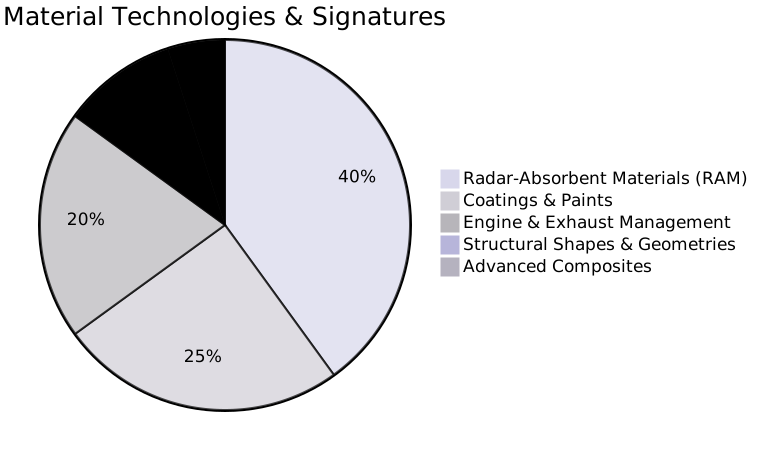
Main insight: RAM and coatings dominate signature reduction, with structural design and materials complementing these efforts.
Signatures and Detection Modalities (Pie Chart)
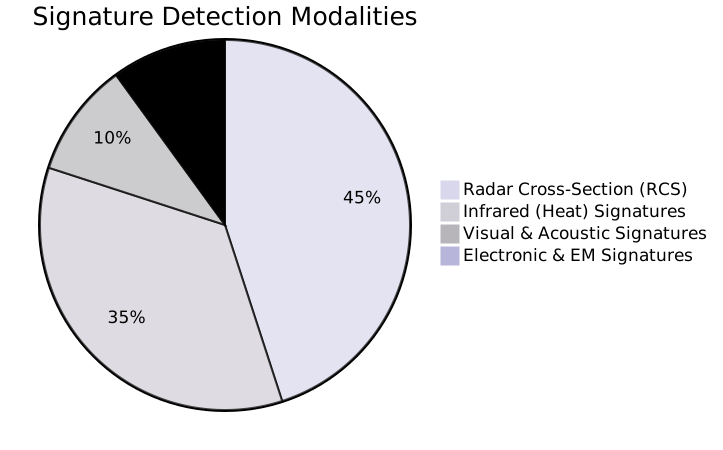
Main insight: Radar and IR signatures are primary detection channels; stealth tech focuses mainly on minimizing these.
Sequence Diagram: Development of Stealth Technologies
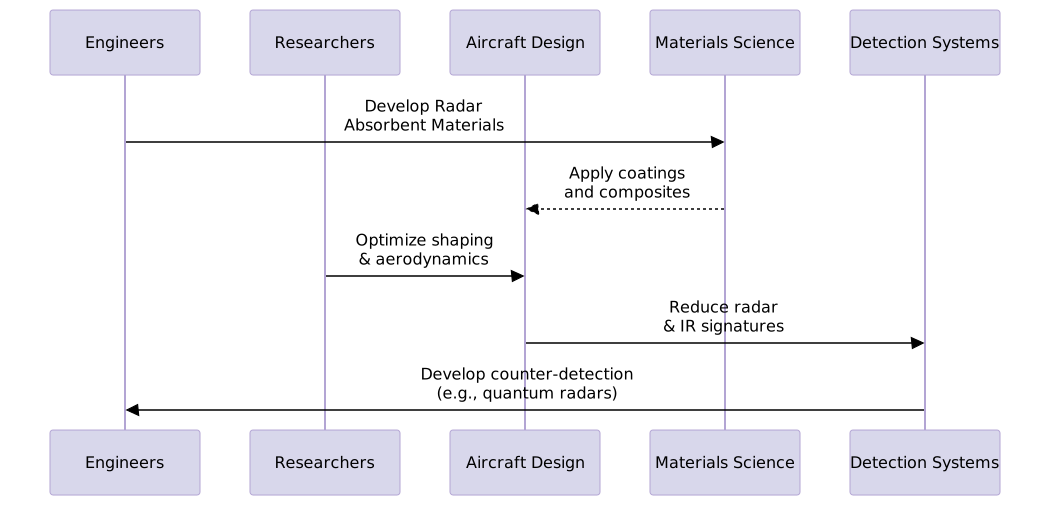
Main insight: Interdisciplinary collaboration advanced stealth through materials, design, and counter-detection tech.
Future Challenges and Countermeasures (Flowchart)

Main insight: Future detection will combine quantum radars and multi-spectral sensors, forcing stealth designs to adapt with new materials, shapes, and electronic countermeasures.
Conclusion
The evolving landscape of radar signature management and detection reveals a constant arms race between stealth technology and detection systems. As a pilot trainer, understanding these principles enhances awareness of both evasion tactics and detection capabilities in modern aerial combat.
Note: The diagrams utilize Mermaid syntax for clarity and detail. For full visual integration, embed in Markdown renderers supporting Mermaid diagrams.
Citation Links
| 118 | https://www.airuniversity.af.edu/Wild-Blue-Yonder/Article-Display/Article/2313184/airpower-in-the-twenty-first-century-swing-and-multi-role-versus-single-role-sp/ | airuniversity.af.edu | 2023-12-04T13:39:05.000Z | |
|
18 A stealth aircraft's need to permanently cover its weaponry has presented an additional problem in respect to the weapons bay and the maintenance of a reduced radar signature. 19 This requirement renders stealth aircraft inferior to a conventional nonstealth fighter20 with regard to weapon readiness status.
|
||||
| 122 | https://www.eurasiantimes.com/china-says-its-heat-seeking-radar-can-detect-a-stealth-aircraft-300/ | eurasiantimes.com | 2023-12-01T23:45:44.000Z | |
|
The radar-evading design features on stealth aircraft do not affect the IRST, as it depends on its infrared (IR) signature alone.
|
||||
| 129 | https://www.slashgear.com/1272089/this-strange-looking-aircraft-was-way-more-advanced-than-it-looks/ | SlashGear | 2023-04-29T17:04:34.000Z | |
|
It has an intriguing and vital place in the history of stealth aircraft , however. Built in the 1980s, the Tacit Blue represented an effort to try and resolve a primary issue facing the development of stealth planes: engines in operation generate tremendous heat. It's difficult to remain hidden when a heat signature lights up like Times Square on radar systems.
|
||||
| 135 | https://www.19fortyfive.com/2022/12/is-russias-su-57-really-a-stealth-fighter/ | 19fortyfive.com | 2023-12-11T00:31:18.000Z | |
|
It certainly may not be as stealthy, and according to TheAviationGeekClub.com, the Felon could hardly be described as a true stealth aircraft. The military aviation website compiled commentary and discussions from a number of aircraft experts, who noted that the Su-57 doesn't come anywhere close to the reduced radar signature of Lockheed Martin's F-22 Raptor or F-35 Lightning II.
|
||||
| 137 | https://www.eurasiantimes.com/lockheed-martin-teases-the-design-of-tailless-sixth-gen-fighter/ | eurasiantimes.com | 2023-12-04T23:57:55.000Z | |
|
The engines of stealth aircraft are often located deep inside the fuselage, which seems to be the case here as well. Stealth is an inevitable characteristic of 6th gen fighters. I think the overall objective would still be to reduce the radar signature reflected from the fighter to the enemy radar."
|
||||
| 140 | https://doi.org/10.1017/S0001924000011702 | G. A. Rao | 2001-12-31T23:59:58.000Z | |
|
Hence, the role of stealth aircraft and the dominance of all aspects of stealth technology, especially in recent conflicts, are reviewed. The integration of the fundamental aspects of stealth technology, through its classification, types of aircraft signatures: especially radar, infrared, and visual signatures, their sources of origin, modelling techniques, and methods of signature reduction are discussed. (2002)
|
||||
| 141 | http://www.scienpress.com/Upload/JCM/Vol%204_1_9.pdf | Konstantinos C. Zikidis | 2013-12-31T23:59:58.000Z | |
|
Low radar signature for a target means that it is detected and tracked at a shorter distance from a radar. However, low observable does not mean no observable, i.e., complete disappearance from the radar screens. Furthermore, stealthiness comes at a price. Apart from the development cost, stealth aircraft have higher flyaway cost and important maintenance costs, while they have significant operational limitations due to the specific aircraft shape imposed and materials used, and also due to the limited fuel and weapons, which have to be carried internally. (2014)
|
||||
| 142 | https://semanticscholar.org/paper/d0171de2610257dcd7d7020539e1d6be07dd0108 | 요헨 돈왈트 | 2011-12-31T23:59:58.000Z | |
|
CONSTITUTION: A stealth aircraft(10) comprises a turbine and bays(20,24). The turbine propels an aircraft having at least one turbine holes(14,16). Other components of the aircraft are received inside the aircraft through the bays. The aircraft is designed to have a small radar signature. (2012)
|
||||
| 143 | https://www.foxnews.com/opinion/chinas-two-new-stealth-fighters-should-send-shockwaves-through-pentagon | Fox News | 2025-01-29T10:50:22.000Z | |
|
It is China's best effort at a true stealth aircraft where the "signature" of its radar reflection, infrared heat emissions, etc. are suppressed and controlled to make it hard to detect.
|
||||
| 144 | https://www.ndtv.com/world-news/how-indian-american-engineer-who-worked-on-b-2-spirit-stealth-bombers-spied-for-china-8750639 | NDTV | 2025-06-24T14:45:42.000Z | |
|
He made significant contributions to reducing the B-2 Spirit bombers' radar and infrared detection capabilities, as well as design factors to reduce its visual signatures. His contributions in the stealth aircraft's exhaust configurations and radar wave-absorbing materials were noteworthy.
|
||||
| 150 | https://en.wikipedia.org/?curid=36263072 | 2025-09-20T13:44:15.000Z | ||
|
The aircraft was developed from the "FC-31 Gyrfalcon" ( ), a stealth aircraft prototype that served as a demonstrator aiming to secure potential export customers after SAC lost the J-XX bid to the Chengdu Aircraft Industry Group . The People's Liberation Army , particularly the PLA Navy , later took an interest in the FC-31 project, leading to the prototype being further developed with a catapult launch bar and folding wing s, and the revised variant took flight on 29 October 2021. A land-based variant emerged in 2023 and was officially debuted ahead of the 2024 China International Aviation & Aerospace Exhibition , receiving the designation J-35A. On 3 September 2025, Chinese state media " China Daily " announced the J-35 and the J-35A to be part of the aircraft fleet of the PLA Navy and the PLAAF .
|
||||
| 162 | https://www.defensemedianetwork.com/stories/darpas-x-planes-and-the-quest-to-redefine-the-boundaries-of-flight/ | defensemedianetwork.com | 2023-03-31T05:25:54.000Z | |
|
By 1977, the world's first practical combat stealth aircraft flew as a DARPA X-plane. DARPA research supporting Have Blue enabled not only RCS reduction through "faceted" stealth shaping, but the development of radar-absorbent materials (RAM), visual-signature-reduction technologies, and jet-exhaust shaping and cooling as well as other infrared-shielding technologies.
|
||||
| 167 | https://asiatimes.com/2021/11/the-real-star-of-israels-blue-flag-air-exercise/ | Asia Times | 2021-11-17T03:33:30.000Z | |
|
IAI says Scorpius can detect stealth aircraft, and for that reason alone is a game-changer. China has developed and deployed the J-20 stealth fighter , modeled on the US F-22, and will soon deploy a lighter stealth fighter called the J-31 . China's twin-engine, multi-role J-20 fighter can reach speeds of 2,100 kilometers per hour. Photo: AFP / ImageChina / Li Jianshu Russia has just announced the Checkmate, its first single-engine jet fighter - which may also include an unmanned version - and is beginning to deploy the Su-57, which has a lower radar signature, though not quite stealth. (2021)
|
||||
| 168 | https://www.wpafb.af.mil/News/Article-Display/Article/2565594/third-event-in-history-heritage-race-series-on-tap/ | wpafb.af.mil | 2023-03-24T17:02:35.000Z | |
|
The Nighthawk is a twin-engine stealth attack aircraft designed purely to evade radar signature. Due to the rise of aerial refueling, it had an unlimited range and carried a payload up to 5,000 pounds. The Air Force and Lockheed Martin were awarded the Collier Trophy in 1989 after collaborating on the Nighthawk, the world's first operational stealth aircraft.
|
||||
| 172 | https://www.eurasiantimes.com/with-us-f-35s-in-mind-russian-conducts-biggest-test-for-the-s-400-systems/ | eurasiantimes.com | 2023-12-01T07:24:18.000Z | |
|
Labeled 'invisible' on the number of occasions by US President Donald Trump, the F-35s have been intricately designed to use stealth technology such as radar-absorbing paint, materials, and the angular lines of its fuselage, which enables them to reduce heat signature and electromagnetic emissions to evade radar systems. However, the S-400s are uniquely designed to counter its stealth technology which masters in identifying and tracking stealth aircraft and hypersonic targets, almost nullifying the F-35's most renowned feature.
|
||||
| 177 | https://doi.org/10.1109/ICORT46471.2019.9069651 | Susmita Garnayak | 2018-12-31T23:59:58.000Z | |
|
The radar absorbent material (RAM) plays significant role in reduction of radar signature by mitigation of radio wave interference used in ships, helicopters, tanks and transport planes. Bio ceramic material composed of china clay and carbon rich waste rice husk ash possesses good dielectric loss for frequency 10 GHz and reflection loss -20 dB which is quite significant for stealth technology. Scanning electron microscopy (SEM) study shows good dispersion of rice husk ash in the epoxy matrix. Frequency dependence of both dielectric constant and dielectric loss are measured in the X band frequency range (8.2GHz-12.4GHz). This low cost laboratory scale synthesized RAM find its application in designing of stealth aircraft and jet fighter for military purposes (2019)
|
||||
| 182 | https://www.eurasiantimes.com/sniffing-stealth-fighters-modern-air-forces-are-banking-on-irst-system/ | eurasiantimes.com | 2023-12-07T05:01:07.000Z | |
|
Modern stealth aircraft like the F-22 Raptor use rectangular exhaust nozzles with a width greater than the height, which, according to experts, restricts the 'look angle' into the hot engine turbine from behind. This way, the hot engine parts of the aircraft are hidden, and its IR signature comes down. Rectangular Nozzles Of The F-22 Raptor (Wikipedia) Furthermore, the exhaust gases from rectangular nozzles do not expand in a conical shape. They mix with the surrounding air faster in a roughly rectangular shape, thereby cooling down quickly and reducing the aircraft's IR signature. The rectangular nozzle also provides rearward stealth to the F-22 over a reasonable radar frequency range.
|
||||
| 185 | https://www.militaryfactory.com/aircraft/detail.php?aircraft_id=757 | militaryfactory.com | 2023-09-24T19:19:31.000Z | |
|
Externally, the Avenger is of a sleek and ultra-modern design, more akin to perhaps Lockheed's style of designing their new range of stealth aircraft such as the F-22 and F-35. She features the perfect blend of curves coupled with sharp angles to best deflate incoming radar signals meant to track her. The forward portion of the fuselage is devoid of features and appears as a cockpit-less snout. Wings are slightly swept back and fitted along amidships, measuring some 66 feet across. There are no horizontal planes as the Avenger was designed with a "Y" type vertical fin assembly covering the form and function of both vertical and horizontal planes as found on conventional aircraft. There is an identifiable air inlet above the fuselage just behind the center portion of the wings to aspirate the jet engine held within. The engine exhausts at the rear through a diminutive "S" shaped exhaust duct to help reduce its heat signature. The venting is shielded from the ground by a short-running panel extending passed the actual exhaust port.. The Avenger is fitted with the General Atomics-developed "Lynx" Synthetic Aperture Radar (SAR) system as well as the AESA Wide-Area Surveillance Sensor. The former is based on the system that will be incorporated into the Lockheed F-35 Lightning II as part of its Electro-Optical Targeting System (EOTS). She is launched and recovered from conventional runways and makes use of a tricycle undercarriage made up of two main landing gear legs and a nose landing gear leg. The Avenger makes use of an internal bomb bay to help keep its radar signature to a minimum.
|
||||
| 187 | https://eurasiantimes.com/invisible-aircraft-how-russian-radars-busted-the-myth-of-stealth/ | eurasiantimes.com | 2023-06-10T01:07:26.000Z | |
|
Extended jet pipes have been introduced, mixing ambient air with exhaust gases, etc., to reduce the heat signature. File Image: J-20 Stealth Aircraft Measures adopted to reduce exhaust gas temperature do achieve marginal reduction. However, extended jet pipe results in reduced stealth characteristics. Similarly, inducting ambient air and mixing it with exhaust results in widening the jet pipe to create additional ducts. Yet again, a wider jet pipe results in a reduction in stealth. All non-stealth aircraft with light grey or light blue under the surface inherently merge with blue sky and are extremely difficult to spot despite clearly audible engine noise. All current stealth aircraft being black in color, both on top and bottom, are clearly visible, thus increasing vulnerability to shoulder launch human-sighted missiles. Design And Technological Stealth All flying objects reflect the impinging radar waves back to the emitter, causing the radar to 'see' the flying machine in all three dimensions.
|
||||
| 202 | https://dailygalaxy.com/2025/01/elon-musk-under-pressure-china-prepares-technology-to-hijack-starlink-satellites-and-track-stealth-aircraft/ | dailygalaxy.com | 2025-01-03T13:59:58.000Z | |
|
Long-Wavelength Radar: Just as radio astronomers use long wavelengths to penetrate dust clouds, some propose using longer-wavelength radar to better detect stealth aircraft. Challenges and Reality While these technologies hold potential, they are not magic solutions. Stealth aircraft are designed to minimize their signature across various detection methods.
|
||||
| 213 | http://www.indiandefencereview.com/news/surviving-stealth-responding-to-low-observable-combat-jet-threat/ | indiandefencereview.com | 2023-06-05T11:05:37.000Z | |
|
While stealth aircraft may elude radar detection, they need powerful engines that unfortunately produce large amounts of waste heat. Hence they might not be as successful in evading advanced IR sensors. Russians sources claim that the F-22 Raptor has been captured in air-to-air IR footage by the OLS-35 electro-optical IRST system of the Sukhoi Su-35S. The claim appears plausible since the Dassault Rafale, the Eurofighter Typhoon and the Boeing F/A-18 Super Hornet are all known to have acquired F-22 jets using similar IRST equipment. IRST depends on the thermal signature emitted by the target, particularly its engine exhaust.
|
||||
| 216 | https://www.eurasiantimes.com/f-22-raptors-us-air-force-uses-its-most-powerful-fighters-to-test-ngad/ | eurasiantimes.com | 2023-11-30T02:14:54.000Z | |
|
If true, this would reduce the effectiveness of infrared search and track (IRST) which depends on the aircraft's infrared signature alone and are unaffected by the radar-evading design features on stealth aircrafts such as F-22, F-117, and F-35. A USAF F-22 Raptor is seen covered in a reflective coating. (Instagram) While these stealth platforms do have inbuilt measures to help reduce their infrared signature, it is still difficult to hide them from increasingly advanced IRSTs that are proliferating around the globe and are present on most of the fighter aircraft being flown by peer adversaries.
|
||||
| 219 | https://worldwide.espacenet.com/patent/search?q=EP4498330A1 | Aymeric Mainvis | 2025-01-28T23:59:58.000Z | |
|
The distribution of the pixel values for the building shown in the pre-event SAR image 420 thus creates a signature statistical characteristic corresponding to the undamaged building. In post-event SAR image 430, the building has been severely damaged by a wildfire. SAR image 430 of a damaged building comprises one or more statistical characteristics indicative of a damaged building. Due to the building having been burnt, layover areas 103 and shadow areas 104 are altered or may no longer exist as a result of the damage to the building 100. The layover areas 103 and shadow areas 104 can be altered due to the structural changes to the building 100 and/or terrain on which the building is situated. The rubble that is left behind by the damaged building 100 also can interact with radar signals quite differently than the angular roof did when it was intact, for example. Since most of the planar surfaces are gone, the rubble produces more incoherent backscattering of the radar beams 101. Somewhat unintuitively, the incoherent backscattering can result in a stronger radar return to the satellite than a highly reflective planar roof, since reflected energy is directional and is only reflected back to the satellite if the angle of the reflective surface is directly perpendicular to the radar beam (this is the same principle for why angular surfaces are used on stealth aircraft where the objective is to reduce the radar signature of the aircraft).
|
||||
| 224 | https://ppubs.uspto.gov/pubwebapp/external.html?q=(20240278486).pn | IMPOSSIBLE OBJECTS, INC | 2024-08-22T04:11:22.000Z | |
|
In some implementations, ferrite particles or other materials can be included with the resin or powder in order to reduce the radar signature of the part for use in stealth aircraft and other radar avoiding devices.
|
||||
| 225 | https://www.indiandefensenews.in/2025/08/india-enters-global-competition-to.html | indiandefensenews.in | 2025-08-06T14:36:46.000Z | |
|
The low heat generation enhances operational sustainability and reduces the thermal signature that could potentially reveal the radar's location to enemy forces. Regional Strategic Implications The development of photonic radar technology occurs within the broader context of India's strategic competition with China and Pakistan in South Asia and the wider Indo-Pacific region. The technology provides India with enhanced capabilities to monitor and defend against advanced military platforms that both neighbouring countries are developing or acquiring. China's rapid military modernisation includes the deployment of advanced stealth aircraft like the J-20 fighter and sophisticated drone swarms that pose challenges to traditional air defence systems. India's photonic radar capability provides a technological counter to these developments, potentially negating some of the advantages that China has sought to achieve through stealth technology investments.
|
||||
| 226 | https://www.indiandefensenews.in/2025/06/tejas-mk-1a-is-slowly-evolving-into.html | indiandefensenews.in | 2025-06-27T07:09:06.000Z | |
|
While not a stealth aircraft, the TEJAS MK-1A benefits from a very low radar cross-section (RCS) thanks to: Radar-absorbing composite materials Clean fuselage design with minimal frontal signature
|
||||
| 228 | https://en.wikipedia.org/?curid=66299 | 2025-09-19T09:58:53.000Z | ||
|
The F-22 incorporates a "Signature Assessment System" which delivers warnings when the radar signature is degraded and necessitates repair. While the F-22's exact RCS is classified , in 2009 Lockheed Martin released information indicating that from certain angles the airplane has an RCS of 0.0001 m 2 or -40 dBsm - equivalent to the radar reflection of a "steel marble"; the aircraft can mount a Luneburg lens reflector to mask its RCS. For missions where stealth is required, the mission capable rate is 62 - 70%. group= N Beginning in 2021, the F-22 has been seen testing a new chrome-like surface coating, speculated to help reduce the F-22's detectability by infrared tracking systems. Front fuselage detail of an F-22 The effectiveness of the stealth characteristics is difficult to gauge. The RCS value is a restrictive measurement of the aircraft's frontal or side area from the perspective of a static radar. When an aircraft maneuvers it exposes a completely different set of angles and surface area, potentially increasing radar observability. Furthermore, the F-22's stealth contouring and radar-absorbent materials are chiefly effective against high-frequency radars, usually found on other aircraft. The effects of Rayleigh scattering and resonance mean that low-frequency radar s such as weather radar s and early-warning radar s are more likely to detect the F-22 due to its physical size. These are also conspicuous, susceptible to clutter , and have low precision. Additionally, while faint or fleeting radar contacts make defenders aware that a stealth aircraft is present, reliably vectoring interception to attack the aircraft is much more challenging. ==
|
||||
| 236 | https://www.sec.gov/Archives/edgar/data/0001133421/0001133421-25-000006-index.htm | NORTHROP GRUMMAN CORP /DE/ | 2025-01-30T16:11:10.000Z | |
|
The company originally was formed in 1939 in Hawthorne, California as Northrop Aircraft Incorporated and was reincorporated in Delaware in 1985, as Northrop Corporation. Northrop Corporation was a principal developer of flying wing technology, including the B-2 Spirit stealth aircraft. We developed into one of the largest defense technology companies in the world through a series of acquisitions, as well as organic growth, including the following: 1994 - Acquired Grumman Corporation, a premier military aircraft systems integrator. The combined company was renamed Northrop Grumman Corporation; 1996 - Acquired the defense and electronics businesses of Westinghouse Electric Corporation, developer of sophisticated radar and other electronics systems; 2001 - Acquired Litton Industries, Inc., a global electronics and information technology company and full service shipbuilder; 2001 - Acquired Newport News Shipbuilding Inc., designer and builder of nuclear-powered aircraft carriers and submarines;
|
||||
| 239 | https://www.sec.gov/Archives/edgar/data/0001564590/0001564590-18-005299-index.htm | ViewRay, Inc | 2018-03-12T16:22:12.000Z | |
|
ViewRay solved this problem by introducing technology similar to that used in stealth aircraft. Stealth aircraft can hide from radar by using a coating that reflects and absorbs microwaves, thus preventing radar beams that strike the aircraft from bouncing back to the radar station. In a similar manner, ViewRay's linac based system reflects and absorbs the output of the linac "radar station" to prevent it from interfering with the MRI, producing images as noise-free as MRI images with no integrated linac. (2018)
|